Showing posts with label Stock Market. Show all posts

Saturday, 18 July 2015

Which One is Good Stoploss or Hedging The Position in share market

I will always vote for hedging than a stop loss while trading. Since I almost always trade nifty options, I will restrict my discussion to options and try to reason why hedging suits me better than a stop loss.

Here are a few reasons why I will always vouch for hedging:
1. No need to worry about your positions. If your view is wrong – the hedged trade is making money. Effectively that is working as a stop loss.
2. You decide when to get out of trade – not a stop loss. In fact you can book profits in one position and leave another position open or initiate another hedge / stop loss strategy.
3. No need to baby-sit the market. You can take time off and feel better. Spend time with you family while still making money. You can leave the trades and go on with your work. Come back after some time to see where you stand and take a decision. In a stop loss, unfortunately though you can leave the system – the stop loss is such a devil that you want to keep watching it and hoping it does not get hit. Eventually it does.
4. Watching one position making money 100% of the time gives more joy.Compare this to the feeling of a position that has just hit a stop loss. 100% loss – no profits.
5. If the trend changes after the stop-loss is hit – there is nothing on this earth you can do about it – except writing a mail to NSE and beg them to reverse the trade which they will not do under any circumstances even if it was their fault. For example afreak trade. You just made a loss and system closed the position. With a hedged position you can leave the trades open for the next hour or day or even few days. More often than not – the trend changes and you can close the trade in profit.
6. You can sleep better in the night as overnight positions can do no harm – remember one positions always keeps you protected. In a stop loss if there is a huge gap opening against your open positions – you will take a stop loss in a market position and see a lot of your money wiped out. It will be a big set back. Some of them can take you out of trading business forever. Hedging will keep you in the game.
7. Sometimes stop loss does not gets executed if the stock/nifty jumps. You are then left at the mercy of the market. Taking a market stop loss will kill you. You will feel miserable for months and will not gather the strength to trade for a long time. This isn’t the case with a hedged position. You will laugh with joy seeing your hedge make a lot of money in a freak second though the other position will be making huge losses. But it will give you time to breath. You won’t freak and press the panic button.
8. Knowing in advance the losses you can make will help you not bother much about your trades so you can take bold decisions and large positions. With a stop loss you can never scale your trades. This is my personal experience that people who put a stop loss never exceed a trade of more than 1 lac. How much will your money grow if you cannot compound? Can you trade 50 lots of nifty call options at Rs. 100.00 even with a stop loss? You have to put Rs. Two lacks and Fifty Thousand on the line. If you somehow felt sick and forgot about the trade and your options expires worthless – all your money is gone. But what happens when you sell a call option with Rs. 75.00 and buy a call option of Value Rs. 100.00? Your maximum loss is 25 points. Now can you trade 50 or even 100 lots? Yes you can.
9. Hedging allows you to do some other work when the markets are open. For instance you can do a part-time or a regular job and still make money. Because there is no need baby-sit your trades. No need to sit six and a half hours in front of your screen. You have to agree with me here – most traders keep watching a trade if there is a stop loss in the system. You cannot do any other job. Your mind will always be with stop-loss. Period.
Some people ask me how to hedge when they are trading stocks in cash intraday. You can but you need to buy/sell a stock that has options available. For example you can buy the stock in cash/futures market if you think it will go up and simultaneously buy a ATM put option. So if your view is wrong the put will make money. In fact if you had bought futures and think that eventually the stock will go up – you can leave this position open overnight and see for the next few days. If the stock rises – you can close the position in profit. Had there been a stop-loss you would have never been able to close it in profit as you have already closed the position in a loss.
Some points to remember:
Hedging should be done simultaneously. Suppose you have bought a call you should sell a call at the same time for the hedge to work effectively.
I have seen many traders get greedy and do not buy a hedge at the same time. They think when the time will come they will buy the hedge. That time never comes and they close the position in a loss.
Hedge gets costly over time if not bought simultaneously. For example if you have bought a call and not sold an OTM call at the same time. If your view was wrong – the OTM calls will get less in value and the money you pocket will be less when you close the potion. So your loss will be bigger.
Suppose you had bought a nifty future and did not buy an ATM put at the same time, and nifty falls. The future has already lost some money that the put option may never be able to recover. Again your losses will be bigger.
Suppose you sold a naked call option and did not hedge and the position is going against you. The calls you want to buy for hedging will become costlier (Nifty is rising) and your profits on the calls will be smaller – again your losses will be bigger than what it would have been had you bought the OTM call as soon as you sold the call.
Note: In some trades however stop-loss makes sense. For example if you are a small trader and you trade only with RS. 10000 intraday cash. Then you have no other option but to put a stop loss in the system. You don’t have enough cash to hedge your position.
Most important note: I like hedging better than stop loss. But that is me not you. Everyone has their own psychology while trading. Some like to work with stop loss and some with hedging. Whatever they are comfortable with. This is my choice and not necessary that you should follow it too. Just try both for some time to decide which one works best for your trades and follow it.
But whatever you do – please please please – either put a stop loss or hedge your position or do both. But never play your trades naked. Stock markets are risky investments and should never be traded without proper insurance. Your insurance can be either a stop loss or a hedged position.

Thursday, 2 July 2015

Short NMDC

Short NMDC for Target 110 ,  cmp @ 117.5

For Accurate Entry & Exit contact me

Thursday, 25 June 2015

Todays Share Market explained in story

If anyone has difficulty understanding the current world financial situation, the following should help.... Once upon a time in a village in India, a man announced to the villagers that he would buy monkeys for $10. The villagers seeing there were many monkeys around, went out to the forest and started catching them.

The man bought thousands at $10, but, as the supply started to diminish, the villagers stopped their efforts. The man further announced that he would now buy at $20. This renewed the efforts of the villagers and they started catching monkeys again.

Soon the supply diminished even further and people started going back to their farms. The offer rate increased to $25 and the supply of monkeys became so little that it was an effort to even see a monkey, let alone catch it!

The man now announced that he would buy monkeys at $50! However, since he had to go to the city on some business, his assistant would now act as buyer, on his behalf.

In the absence of the man, the assistant told the villagers: 'Look at all these monkeys in the big cage that the man has collected. I will sell them to you at $35 and when he returns from the city, you can sell them back to him for $50.'

The villagers squeezed together their savings and bought all the monkeys.

Then they never saw the man or his assistant again, only monkeys everywhere! 

Larry Williams's Investing Rules


1. It's all about survival:
No platitudes here, speculating is very dangerous business. It is not about winning or losing, it is about surviving the lows and the highs. If you don't survive, you can't win.

The first requirement of survival is that you must have a premise to speculate upon. Rumors, tips, full moons and feelings are not a premise. A premise suggests there is an underlying truth to what you are taking action upon. A short-term trader's premise may be different from a long-term player's but they both need to have proven logic and tools. Most investors and traders spend more time figuring out which laptop to buy than they do before plunking down tens of thousands of dollars on a snap decision, or one based upon totally fallacious reasoning.

There is some rhyme and reason to how, why and when markets move - not enough - but it is there. The problem is that there are more techniques that don't work, than there are techniques that do. I suggest you spend an immense and inordinate amount of time and effort learning these critical elements before entering the foray of financial frolics.

So, you have money management under control, have a valid system, approach or premise to act upon - you still need control of yourself.


2. Ultimately this is an emotional game - always has been, always will be:
Anytime money is involved - your money - blood boils, sweaty hands prevail, and mental processes are shortcircuited by illogical emotions. Just when most traders buy, they should have sold! Or, fear, a major emotion, scares them away from a great trade/investment. Or, their bet is way too big. The money management decision becomes an emotional one, not one of logic.


3. Greed prevails - proving you are more motivated by greed than fear and understanding the difference:
The mere fact you are a speculator means you have less fear than a 'normal' person does. You are more motivated by making money. Other people are more motivated by not losing.

Greed is the trader's Achilles' heel. Greed will keep hopes alive, encourage you to hold on to losing trades and nail down winners too soon. Hope is your worst enemy because it causes you to dream of great profits, to enter an unreal world. Trust me, the world of speculating is very real, people lose all they have, marriages are broken up, families tossed asunder by either enormous gains or losses.

My approach to this is to not take any of it very seriously; the winnings may be fleeting, always pursued by the taxman, lawyers and nefarious investment schemes.

How you handle greed is different than I do, so I cannot give an absolute maxim here, but I can tell you this, you must get it in control or you will not survive.


4. Fear inhibits risk taking - just when you should take risk:
Fear causes you to not do what you should do. You frighten yourself out of trades that are winners in deference to trades that lose or go nowhere. Succinctly stated, greed causes you to do what we should not do, fear causes us to not do what we should do.

Fear, psychologists say, causes you to freeze up. Speculators act like a deer caught in the headlights of a car. They can see the car - a losing trade, coming at them - at 120 miles per hour - but they fail to take the action they should.

Worse yet, they take a pass on the winning trades. Why, I do not know. But I do know this: the more frightened I am of taking a trade the greater the probabilities are it will be a winning trade. Most investors scare themselves out of greatness.


5. Money management is the creation of wealth:
Sure, you can make money as a trader or investor, have a good time, and get some great stories to tell. But, the extrapolation of profits will not come as much from your trading and investing skills as how you manage your money.

I'm probably best known for winning the Robbins World Cup Trading Championship, turning $10,000 into $1,100,000.00 in 12 months. That was real money, real trades, and real time performance. For years people have asked for my trades to figure out how I did it. I gladly oblige them, they will learn little there - what created the gargantuan gain was not great trading ability nearly as much as the very aggressive form of money management I used. The approach was to buy more contracts when I had more equity in my account, cut back when I had less. That's what made the cool million smackers - not some great trading skill. Ten years later my 16-year-old daughter won the same trading contest taking $10,000 to $110,000.00 (The second best performance in the 20-year history of the championship). Did she have any trading secret, any magical chart, line, and formula? No. She simply followed a decent system of trading, backed with a superior form of money management.


6. Big money does not make big bets:
You have probably read the stories of what I call the swashbuckler traders, like Jesse Livermore, John 'bet a millions' Gates, Niederhoffer, Frankie Joe and the like. They all ultimately made big bets and lost big time.

Smart money never bets big. Why should it? You can win big on small bets, see #5 above, but eventually if you bet big you will lose - and you will lose big.

It's like Russian Roulette. You may well spin the chamber holding the bullet many times and never lose. But spin it often enough and there can be only one result: death. If you make big bets you are destined to be a big loser. Plunging is a loser's game; it can only set you up for failure. I never bet big (I used to - been there and done that and trust me, it is no way to live). I bet a small per cent of my account, bankroll if you will. that way I have controlled loss. There can be no survival without damage control.


7. God may delay but God does not deny:
I never know when during a year I will make my money. It may be on the first trade of the year, or the last (though I hope not). Victory is out there to be grasped, but you must be prepared to do battle for a long period of time.

Additionally, while far from a religious person, I think the belief in a much higher power, God, is critical to success as a trader. It helps puts wins and losses into perspective, enables you to persevere through lots of pain and punishment when you know that ultimately all will be right or rewarded in some fashion. God and the markets is not a fashionable concept - I would never abuse what little connection I have with God to pray for profits. Yet that connection is what keeps people going in times of strife, in fox holes and commodity pits.


8. I believe the trade I'm in right now will be a loser:
This is my most powerful belief and asset as a trader. Most would be wannabes are certain they will make a killing on their next trade. These folks have been to some 'Pump 'em up, plastic coat their lives' motivational meeting where they were told to think positive thoughts. They took lessons in affirming their future would be great. They believe their next trade will be a winner.

Not me! I believe at the bottom of my core it will be a loser. I ask you this question - who will have their stops in and take right action, me or the fellow pumped up on an irrational belief he's figured out the market? Who will plunge, the positive affirmer or me?

If you have not figured that one out - I'll tell you; I will succeed simply because I am under no delusion that I will win. Accordingly, my action will be that of an impeccable warrior. I will protect myself in all fashion, at all times - I will not become run away with hope and unreality.


9. Your fortune will come from your focus - focus on one market or one technique:
A jack of all trades will never become a winning tradee. Why? Because a trader must zero in on the markets, paying attention to the details of trading without allowing his emotions to intervene.

A moment of distraction is costly in this business. Lack of attention may mean you don't take the trade you should, or neglect a trade that leads to great cost.

Focus, to me, means not only focusing on the task at hand but also narrowing your scope of trading to either one or two markets or to the specific approach of a trading technique.

Have you ever tried juggling? It's pretty hard to learn to keep three balls in the area at one time. Most people can learn to watch those 'details' after about 3 hours or practice. Add one ball, one more detail to the mess, and few, very few, people can make it as a juggler. It's precisely that difficult to keep your eyes on just one more 'chunk' of data.

Looks at the great athletes - they focus on one sport. Artists work on one primary business, musicians don't sing country western and Opera and become stars. The better your focus, in whatever you do, the greater your success will become.


10. When in doubt, or all else fails - go back to Rule One.

Option writing for Delivery shares

BUY LOT QUANITY IN DELIVERY
HOLD ON DELIVERY
FIX A TARGET PRICE
SHORT CALL OPTION OF TARGET PRICE

EXAAMPLE IF ANY BODY LONG IN HINDALCO AND HIS TARGET PRICE IS 130
THEN SHORT 130CALL AND ENJOY PRIMIUM AS DIVIDEND OF JULY MONTH

Tuesday, 23 June 2015

Get Rich for Beginners

1. Have longer term view
Buffet says money doesn’t grow overnight. ” No matter how great the talent or efforts, some things just take time. You can’t produce a baby in one month by getting nine women pregnant. ” So your investment planing should be done by considering longer terms goal. People go for futures & options with the hope of making quick money but they are actually the one who loses more money than average investors. All the big names who have made good money from the market are long term investors only. Buffet never did intra day or positional trading. Buffet also says if you cant own the stock for 10 years don’t even own it for 10 minutes.

2. Prefer quality stocks than cheap stocks
Lot of investors buy stocks just because they are cheap without understanding that cheap is not always better. Buffet learned from Charlie Munger that “it is far better to buy a wonderful business at a fair price than to buy a fair business at a wonderful price.” Chances of losing money in cheap stocks are very high comparing to investment in a fairly valued stock.

warren buffet investment tips

3. Have Contra View
Warren Buffet says “be fearful when others are greedy, and greedy when others are fearful.” That means buy when there is panic in the market when everyone is bearish. Sell when everyone is bullish on the market. Most of the people fail to follow this because of excessive fear when the market is going down and excessive greed when the market is going up. When the market is going up everyone speaks only about the positive side which increases the greed that makes people to carry their long position and also to take fresh position at higher levels. Fall from the higher levels is always very intense and most of the traders lose money.
The same goes when the market is falling down. During panic all experts and media talks only about the negative side. They speaks as if the market will always continue to fall forever. People keep waiting for the stocks to become cheaper and ultimately miss the right opportunity to buy.

4. Don’t invest in any company whose business you don’t understand
Many people invest their money just by hearing anything good about the particular company from others. By understanding the business, you can determine if there will be any associated financial problems in the future. There are many companies in the stock market whose business can be understood by any normal people.

5. Think like an owner
Evaluate stocks exactly the same way as if someone offered to sell you the entire company. Thinking like an owner changes your whole perspective on stock investing. If you are going to own a new car, you will think about its fair valuation, you will think about its features and you will compare it with cars offered by other manufactures from the same segment. Then after checking everything you will decide which one to buy. Like wise you should have same prospective with stocks.

6. Stay away from hot stocks
Some stocks always remain in news and grabs the attention of many. Stay away from such stocks which are highly volatile. Warren Buffett once said, “Most people get interested in stocks when everyone else is. The time to get interested is when no one else is. You can’t buy what is popular and do well.

7. Don’t keep the loss making shares.
When the share price has fallen down by 50%, many people choose to wait. They convince themselves and others by saying “It will definitely come back”. And many times people quickly book the profit when the stock price goes up by just 10% . If the fundamentals of the stocks become poor, exit it immediately don’t wait for anything and never average it. And stay invested if the fundamentals and future prospectus are strong. Don’t be in rush to book small profit in such stocks.

8. Avoid Borrowing
You can buy anything by taking loans and borrowing money, but you become rich by living on borrowed money. People initially think that they can manage their debts but not everyone can do so. One needs to have a solid plan to pay the debt back and not become its lifetime slave. A debt-free life is the best life. Buffet says I’ve seen more people fail because of liquor and leverage – leverage being borrowed money. You really don’t need leverage in this world much. If you’re smart, you’re going to make a lot of money without borrowing.

9. Spend you money wisely
Money saved is money earned. Warren Buffet says If you buy things you don’t need, you will soon sell things you need. Humans have the urge to have all the luxuries of the world . Every rupee spent on unnecessary urges contributes to lost wealth. Before spending money on anything ask few questions to yourself. Do I really need this? Am I overspending? Can I save some money without compromising on the value I want from a particular product/service?

10. Always be prepared for the worst.
Stock market is a place where nothing is certain. So always be prepared for the worst. Many tragedies can happen overnight that can destroy your capital. Problems doesn’t gives any warning before coming. Always save some funds for emergencies and never expose your full capital in any investment option.

By Warren Buffet

Trading With Bollinger Band and RSI

Bollinger Bands
Bollinger bands are an integral part of just about every charting system I have ever seen but many traders are unfamiliar with how to use them. In this lesson we will cover the basics of Bollinger bands and one particular technique which I have found to be very reliable.
History
Bollinger Bands were invented by John Bollinger as a means of determining what could be considered as high or low around a give price.
The bands are plotted at a standard deviation (statistical term for measuring volatility) around a moving average. Typically the standard deviation used is 2.
The bands appear on charts as 3 bands.
A simple moving average  in the middle. Most charting software defaults to a 20 period moving average.
An upper band calculated around a simple moving average plus 2 standard deviations.
A lower band calculated around a simple moving average minus 2 standard deviations.
For our examples we will use the most common setting of a 20 period simple moving average. This will give us 3 bands, the middle band of a 20 period simple moving average and the upper and lower bands calculated around the middle band with standard deviation of 2. The closing price is most commonly used to calculate the moving average.
Bollinger bands can be used to generate buy and sell signals but that is not their primary use. The main purpose of the bands are to:
To identify areas of high and low volatility.
To identify periods when prices are at an extreme and possibly ready for a reversal.
To identify a trending market.
See Chart Below


The Squeeze
The squeeze (tightening) is a period of low volatility and often happens before a big move. It can also help identify potential breakout areas.
Reversal
In conjunction with other indicators you can identify potential reversal points.
Trending Following
Although Bollinger bands will not tell you when the trend has started if you combine it with certain indicators they will confirm the trend. It is also easily identifiable visually.
My Use Of Bollinger Bands
As I mentioned earlier Bollinger bands are not really meant to be used as a signal generating indicator but in conjunction with another indictors can be very useful.
I like to use Bollinger bands and RSI together to generate possible buy and sell signals or to confirm overbought or oversold areas.
I normally set the RSI at 14 and when it reads over 70 and price is at or pushing through the upper band then I know we are overbought and ready for a reversal. I will either start thinking about shorting the market or if I am already in a long position will start to cover.
When the RSI reads below 30 and price is touching or pushing through the lower band then I know we are oversold and I will either consider buying the market or close existing short positions.
See Chart


Nifty PE Ratio


Nifty PE ratio measures the average PE ratio of the Nifty 50 companies covered by the Nifty Index. PE ratio is also known as "price multiple" or "earnings multiple". If P/E is 15, it means Nifty is 15 times its earnings. Nifty is considered to be in oversold range when Nifty PE value is below 14 and it's considered to be in overvalued range when Nifty PE is near or above 22. The market quickly bounces back from the oversold region because intelligent investors start buying stocks looking to snatch up bargains and they do the exact opposite when Nifty P/E is in the overbought region.

Check out what Professor Bakshi (a famous Indian value investor ) has to say about Nifty P/E. Recent research done by my firm shows just how dangerous it is to remain invested in an expensive market. Since NSE started, every time when Nifty's Price/Earnings ratio exceeded 22, the average return from Indian equities over the subsequent three years became negative.

Nifty PE analysis

History clearly tells us that if you are a passive long term investor you should buy stocks when P/E reaches 15-16 and stop buying when P/E goes above 22.

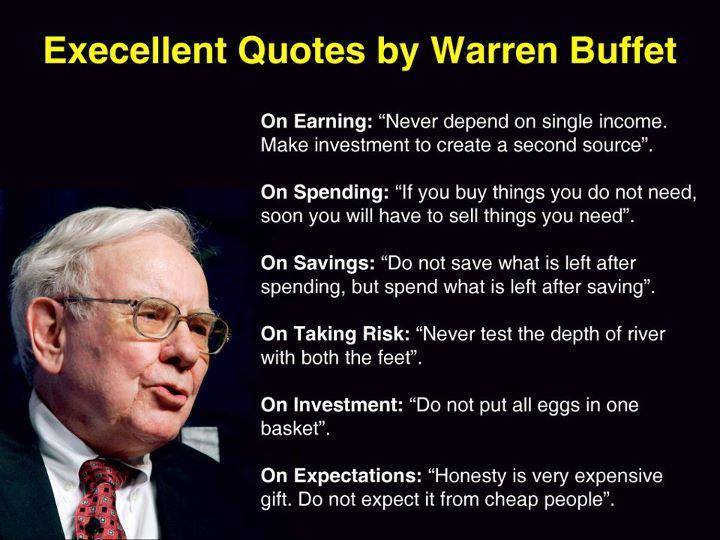
My Favourite quotes from Warren Bufffet


Stock Market Investment Tips For beginners


Stock Market Investment is a good method of making money only When you do it with much care and attention. Most people think that stock market is good place to make money. If so all stock traders and stock market investors must become multi millionaires and billionaires. But the reality is not that. When you try to invest in stockmarket, learn the market and the stock well and starts only after collecting all information and necessary analysis.
You must be aware that nobody can become rich through stock market within a short time. When you enter into stock market you should know this fact and go ahead only with the real facts. You should not trust the advertisements and rumors. Learn everything well and go ahead with confidence.
Invest in a particular stock or in a particular sector only after doing careful market study and independent analysis of the stock you wish to buy. You must not believe others, even if it is the top most investment guru Warren Buffet, without proper self study.
Give much attention to stock investment and watch the market carefully. You never think that you can be a good trader by doing stock trade just like a part- time work or as a hobby. You can do stock trade as part time work or as hobby, but the net result will be a heavy loss.
Do not follow blindly the activities of the other traders, friends or large scale investors. If you follow others the net result will be a loss. You may watch chess while others playing. There may be many ideas in your mind when others playing. But that might not be the idea of the player. Just like in stock trading you could not watch and follow others.
When you invest in stock market, it must not be for a short period. If you do so no doubt you would be a looser in stock market. Stock market trading is just like planting trees. You could not harvest in a short while. Wait enough time to get a good harvest.
When you invest in stocks of a particular company, study all the activities of the company including their business, management, financial status, popularity, goodwill etc. You must know that if you invest in shares of strong companies no doubt you can yield a good profit, if you are ready to wait for enough time.
Do not be panic while selling or buying shares. The market trend be tempting you to sell or buy shares in a particular time. Whenever you sell or buy stock, do it only after a good market study and analysis. This is not a gambling. This is a real scientific trade which has its own principles and methods. So don’t be panic or greedy.
Never enter in stock market with borrowed money. If you take a loan or borrow money from any friends or relatives, to invest in stock market, you could not refund it in right time. The stock marketis volatile and one could not foresee the real position of stock market after a stipulated time.
Never invest in stock market with the money you are earmarked for a specified purpose. You could not realize the money when you are urgently needs the money, unless you are not ready to bear a heavy loss. The money you invest in stock market could not easily realize with profit while you hardly need the money.
Do not follow rumors, analyst report, hot stock tips or recommendations of the stock broker. Their strategy or ideas may not help you to get a good profit. They are making such recommendations as a common strategy which may not be suitable for you. All readymade dresses are not suitable for all. You also have a dress in your own measurements. So do not follow blindly such common evaluations.
Diversify your portfolio in a balanced way. Do not over diversify or under diversify. Do it an optimum way of diversification. Only experience can help you here. You can be a good stock trader in a certain period of time with hard work and quality market study. Always remember that Rome is not built in a day.
If you follow all the above mentioned tips, you can be a profitable stock trader and can make money from stock market investment in rainy days or sunny days, in bullish trend or in bearish trend.
(Author – Shyam Dutt Sharma – A CA final student- 
Taxguru

Monday, 22 June 2015

Warren Buffett Quotes on Investment

"The best thing that happens to us is when a great company gets into temporary trouble…We want to buy them when they're on the operating table." 
"I try to buy stock in businesses that are so wonderful that an idiot can run them. Because sooner or later, one will." 
"Whether we're talking about socks or stocks, I like buying quality merchandise when it is marked down." 
"It's far better to buy a wonderful company at a fair price than a fair company at a wonderful price."
"Wall Street is the only place that people ride to in a Rolls-Royce to get advice from those who take the subway." 
"When you combine ignorance and leverage, you get some pretty interesting results." – talking about how brokers and analysts, even the young and inexperienced ones, are always quick to give advice, regardless whether it's good or not, 2008.
"Risk comes from not knowing what you're doing.
"The investor of today does not profit from yesterday's growth."
"Someone is sitting in the shade today because someone planted a tree a long time ago." 
Warren Buffett Quotes for Long term investment
"When we own portions of outstanding businesses with outstanding managements, our favorite holding period is forever." 
"I never attempt to make money on the stock market. I buy on the assumption that they could close the market the next day and not reopen it for five years." 
"Buy into a company because you want to own it, not because you want the stock to go up." 
"You only have to do a very few things right in your life so long as you don't do too many things wrong."
"Time is the friend of the wonderful business, the enemy of the mediocre."
"Investors should remember that excitement and expenses are their enemies."
Warren Buffett Quotes on When to Sell
"The most important thing to do if you find yourself in a hole is to stop digging."
"Should you find yourself in a chronically leaking boat, energy devoted to changing vessels is likely to be more productive than energy devoted to patching leaks.
Warren Buffett Quotes on Being a Contrarian
"You're dealing with a lot of silly people in the marketplace; it's like a great big casino and everyone else is boozing. If you can stick with Pepsi, you should be O.K." 
"You want to be greedy when others are fearful. You want to be fearful when others are greedy. It's that simple."
"After all, you only find out who is swimming naked when the tide goes out." 
Warren Buffett Quotes on the Right Mindset
"If past history was all there was to the game, the richest people would be librarians."
"You don't need to be a rocket scientist. Investing is not a game where the guy with the 160 IQ beats the guy with 130 IQ."
Warren Buffett's Biggest Rule of All
"Rule No. 1: never lose money; rule No. 2: don't forget rule No. 1." 
Rs 10,000 becomes Rs 413 crores in 29 Years - Must Read
Suppose You Bought Wipro 100 share value Rs. 100 in 1980
1981 ,1:1 Bonus =200 shares
1985,1:1 Bonus =400 shares
1986 split to Rs 10 =4000 shares
1987,1 :1 Bonus =8000
1989, 1:1 Bonus =16000
1992 ,1:1 Bonus =32000
1995 ,1:1 Bonus =64000
1997 ,2:1 Bonus =1,92,000
1999 Split to Rs 2 =9,60,000
2004 2:1 Bonus =28,80,000
2005 1:1 Bonus =57,60,000
2010 3:2 Bonus =96,00,000
Today’s Rate Rs 431
You Earn Rs 413 Crore !!
If a business does well, the stock eventually follows-Warren Buffett

"An investment in knowledge pays the best interest." - Benjamin Franklin
When it comes to investing, nothing will pay off more than educating yourself.
 Do the necessary research, study and analysis before making any investment decisions.
General Market Advice:
1. Never chase a stock.
2. Buy when markets are in the grip of panic.
3. Only buy fundamentally strong stocks, which are undervalued.
4. Buy stocks grown in top line and bottom line over the past years.
5. Invest in companies with proven management.
6. Avoid loss-making companies.
7. PE Ratio and Growth in earnings per share are the key.
8. Look for the dividend paying record.
9. Invest in stocks for sure returns.
10. Stocks have been the high yielding asset class over the past.
11. Stocks are an asset class.
12. The basic property of any asset class is to grow.
13. Buy when everyone is selling and sell when everyone buys.
14. Invest a fixed amount each month.
Rich people have their money work hard for them.
Rich people knows how to look for an opportunity, invest it and then see their money 'growing'. But most people work hard for money. They sacrifice their time for more money.